

Measure physical function with less manual work.
Kinegrade helps healthcare teams run standardized physical function assessments in the clinic or at home, and follow results over time without adding a separate appointment for every reassessment.
Patient overview
Longitudinal function data · Rehab pathway| Date | 5× STS | Status |
|---|---|---|
| Sep 17 | Pending | Awaiting |
| Sep 03 | 15.8 s | Previous |
| Aug 14 | 17.1 s | Baseline |
5× Sit-to-Stand
SetupPlace your phone so I can see your full body and the chair.
Detect functional decline and recovery earlier.
Standardized mobility tests help show whether physical function is changing. In practice, repeat measurements often depend on clinic time, staff availability and another patient visit. That makes regular follow-up harder to maintain.
Kinegrade is designed to let suitable reassessments happen in the clinic or at home. Results are stored in the same patient view so clinicians can follow change over time without adding unnecessary measurement visits.
Reduce routine measurement work.
Use guided reassessments for suitable tests and keep clinician time focused on care that requires clinical judgement.
Review progress in one place.
See repeated results and reassessment status in one patient view instead of checking separate visit records.
Complete suitable tests at home.
A patient can complete a guided reassessment between visits when a separate clinic appointment is not necessary.
A simple reassessment workflow.
The same basic process can be used in the clinic and for supported remote reassessments.
Guide the test
Run a supported standardized assessment with step-by-step instructions and positioning checks.
Record the result
The measurement is saved to the patient view in Kinegrade automatically, reducing separate manual documentation.
Review change over time
Compare repeated results to see how physical function is changing and when follow-up may be needed.
How Kinegrade works.
Kinegrade combines guided assessments, camera-based movement analysis and repeated outcome tracking. The aim is to make standardized physical function measurement easier to repeat and easier to review.
Camera-based motion analysis
For supported tests, the smartphone camera can be used to detect relevant movement and positioning without dedicated motion-capture equipment.
Guided patient assessments
The patient receives step-by-step instructions, positioning feedback and basic quality checks during the assessment.
Automated measurement and result capture
Supported test results can be calculated and added to the patient timeline without a separate timing or data-entry step.
Longitudinal clinician dashboard
Clinicians can review repeated measurements, trends and upcoming reassessments in one place.
Follow results over time.
A single measurement shows the current result. Repeated measurements show whether it is changing.
Kinegrade keeps repeated physical function results in one patient view so clinicians can review progress without piecing together separate records.

More consistent information for follow-up.
Regular physical function measurements can give clinicians better context when reviewing progress and deciding whether follow-up is needed.
Support clinical review.
Repeated objective measurements provide additional information when assessing progress, recovery or decline.
Adjust follow-up to the patient.
Changes over time can help clinicians decide whether the current plan is working or whether the patient should be reviewed.
Identify changes between visits.
Remote reassessments can provide additional information between scheduled appointments when the clinician considers a test suitable for home use.
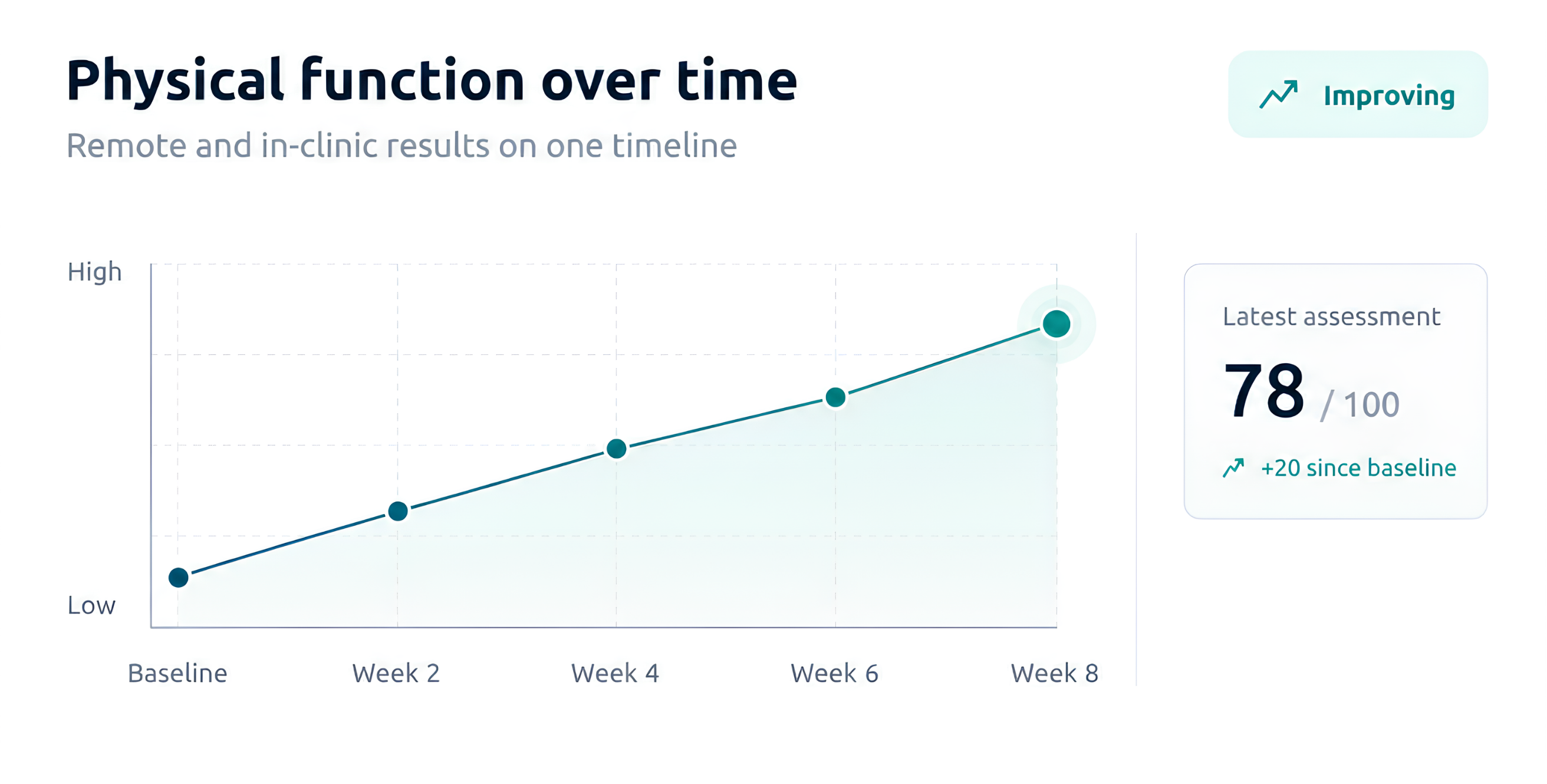
Reassess in the clinic or at home.
For suitable tests, the same guided workflow can be used during a clinic visit or as a remote reassessment between visits.
Complete selected tests at home.
Patients can complete supported reassessments between visits when remote measurement is appropriate.
Use the same assessment workflow.
Clinicians can run the same guided test during an appointment and keep the result in the same patient view.
Keep measurements in the same patient view.
Clinic and remote results are stored together so they can be compared over time.
Designed to complement existing systems.
Kinegrade is intended to work alongside the patient-record system, not replace it.
Measurements from supported smartphone assessments, clinical tests, devices and patient-reported outcomes can be brought into one longitudinal view of physical function.
Use the same measurement structure across clinics.
A consistent approach to reassessment can make follow-up activity and physical function outcomes easier to review across teams and locations.
Kinegrade can start with a single clinic workflow and expand to other teams as the assessment model and integrations are validated.
Interested in testing Kinegrade in practice?
We are looking for clinics and rehabilitation teams interested in early product testing, workflow feedback and pilot discussions.
Join early access
Pilot discussions, early access and product updates.